 from
from

In the 250 years since we declared independence from England, there’s still much that divides us. For example, how we feel about Scotland. Americans love Braveheart and fell in love with the Tartan Army when they invaded Boston and Miami to watch Scotland in the World Cup. The English not so much. Also, how we deal with our leaders. In the U.S., unpopular and/or unhinged leaders must be abided for four years while the English chop and change on a whim; in the decade since the regrettable decision to leave the EU, they’ve had six prime ministers with a seventh on the way.
Which raises another major difference. Americans elected to public office celebrate with supporters in cloistered hotel ballrooms, away from opponents. But in English elections, all candidates gather at a central venue – a town hall or leisure centre – to hear the returning officer formally declare the count: each candidate and number of votes received. In anticipation of this made-for-media moment, seats contested by aspiring leaders attract attention-seeking candidates who wish to appear on the same stage. Screaming Lord Sutch, founder of the Monster Raving Loony Party, enjoyed standing next to prime ministers in his top hat and leopard print jacket. Mr. Blobby, a bulbous pink figure with yellow spots and green jiggling eyes, ran for Parliament back in the ‘90s, succeeded by Elmo in more recent elections.
With the June 18 election of former Manchester Mayor (and next Prime Minister) Andy Burnham in Manchester-adjacent Makersfield, standing next to him on the conference center stage was none other than Count Binface. The heir to Lord Buckethead, who arrived at Prime Minister Theresa May’s 2017 Maidenhead count menacingly complaining about the service at Pizza Express, Count Binface wears a tall dustbin-shaped helmet and long silver cape, once challenged Lord Buckethead to “a receptable-to-receptable debate,” and his platform includes nationalizing model railways, nationalizing Adele, and moving the hand dryer in the men's toilet at Uxbridge's Crown and Treaty pub to a more sensible position. At the Makersfield declaration, Burnham was positioned onstage between Count Binface and a candidate dressed as a fox. Following his election, Burnham talked amiably with Count Binface, demonstrating yet another difference: if he’s reluctant to pose for a photo with the Prime Minister of Italy, would Baron Orangeface stoop to chat with Count Binface?
One of Burnham’s priorities is new home construction. We have that in common, as demonstrated by the new bipartisan housing bill our mercurial President championed and now refuses to sign. I’ve previously written about our shortage of affordable housing and its roots in workforce: 260,000 unfilled jobs in the building trades. Now it’s clear that we also don’t have enough skilled labor to build the data centers Big Tech thinks we need, and that skyrocketing demand for these workers will put further upward pressure on the cost of all new construction.
Corporate America has responded with a series of headline-grabbing training initiatives. Google announced a $50M commitment that’s somehow supposed to train 300,000 tradespeople. (At $166.70 per new worker, it’s the fantastical sequel to Google’s Covid-era couldn’t-miss-launch of asynchronous online courses to equip 100,000 low-income Americans with digital skills.) Lowe’s says they’re investing $250M over the next decade to train 250,000 tradespeople – presumably with tools Lowe’s actually sells, so at least not online. Blackrock is plunking down $100M on plumbers.
But since train-and-pray programs are unlikely to close the construction talent gap, three other initiatives are more promising. Meta is investing $115M to create something called America’s Workforce Academy, a place-based training program starting in four red states. Meta’s plan is to pay students to learn and guarantee a job upon completion of training. Bloomberg Philanthropies announced a $90M effort to train 15,000 high school students in the building trades with a goal of advancing 2,000 into apprenticeships. (Unlike Meta, Bloomberg thinks it’s also important to train in blue states.) Finally and most exciting, last week former Commerce Secretary Gina Raimondo announced Raise Us, a new nonprofit that will invest $500M in new models for redeploying workers, including into the building trades. All these plans acknowledge the experience gap, namely that training without arranging relevant work experience is often futile.
Still, as a recent Work Shift headline states, “employers can’t fix a broken system one training program at a time.” In fact, the building talent bottleneck isn’t availability of curriculum, training programs, or interest in the trades; with growing awareness of high wages and unfilled jobs, interest among young adults has doubled in the past decade. The choke point is licensure – i.e., the ability to make a reasonable living independently (without supervision) – and the barriers thereto.
***
The career ladder is similar across nearly all building trades: complete a vocational training program, find your way into an apprentice job, work enough hours under the supervision of experienced professionals and pass an exam administered by a state board to achieve journeyman status (i.e., licensure), then perhaps become a master, which means being able to run your own contracting business and pull permits. So solving the trade talent gap means producing more journeymen. Journeyman is derived from the French journée (day) and connotes a day’s work. The goal should be hundreds of thousands more Americans permitted to do a day’s work building the residential, commercial, and industrial infrastructure we need.
One obvious issue is that trades are licensed at the state level and each state sets its own supervision requirements for apprentices i.e., how many journeymen required per apprentice. The most common ratio across trades and states is 1:1, then 1:3 for subsequent apprentices, meaning a second apprentice requires four journeymen and a third requires seven. Union-dominated trades and states have stricter ratios as did the Biden Administration’s union-inflected Inflation Reduction Act, which required 1:1 ratios for IRA-funded projects. Across all trades Pennsylvania infamously requires four journeymen per apprentice, as do Maryland and New Jersey. For New Jersey ironworkers, five journeymen are required for the first apprentice, but the second requires 10 more journeymen and the third 20 more after that. In all states, ratios are applied per trade, not across an entire project or site, and enforced daily, meaning that if a journeyman calls in sick, an apprentice may not be able to work. Rigid supervision requirements mean that even if builders want to hire more apprentices, they can’t, creating a severe bottleneck at the top of the talent funnel.
But the more fundamental problem is something else we have in common with England: the monolithic journeyman standard. As this chart shows, becoming a journeyman takes at least two years and up to six to become a licensed electrician or plumber in states with powerful unions.
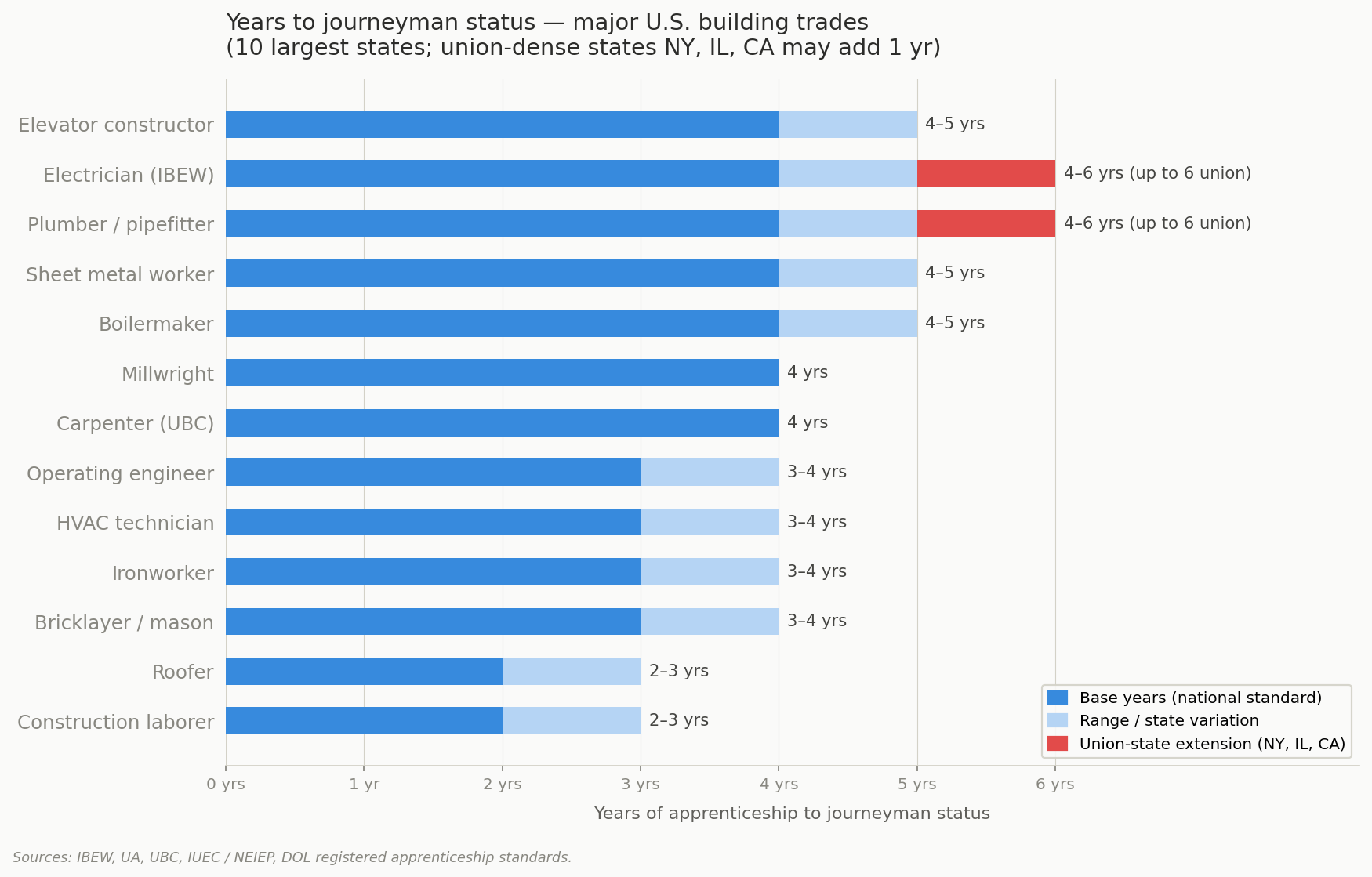
In these trades, the journeyman standard is the sole standard. Journeymen are trained across the full spectrum of work they might encounter. For example, journeymen electricians are capable of working on residential wiring, commercial distribution systems, industrial motor controls, low-voltage systems, and standby power. Journeymen plumbers have demonstrated competence across water supply systems, sanitary drainage and venting, storm drainage, gas piping and appliance connections, and heating systems. So whether or not electricians and plumbers ever work on a commercial or industrial job, they had to prove they could to get their license.
If a single broad credential as prerequisite for career launch sounds familiar, it may be because you have a bachelor’s degree. But as America wakes up and realizes not every worker should need four years of postsecondary education – at least not to begin their career journey – it’s equally clear that not every construction worker should need a journeyman credential before being allowed to work independently.
Why can’t states create narrower credentials with shorter timeframes? Like separately licensing low-voltage electricians, residential water-and-drain plumbers, and data center HVAC specialists? Reducing the quantity of new trade workers forced to work as apprentices is the simplest answer to the ratio problem. It would also allow more new workers to make a real living – i.e., more than a discounted apprentice wage – sooner.
A few states have taken a few small steps. Oregon issues a limited energy technician license after two years, allowing independent work on low-voltage systems. Adding fire alarms requires an additional year. Arkansas likewise licenses residential electricians after two years. West Virginia issues a single-family dwelling specialty license that carves residential electrical work out of the full journeyman credential. Finally, last year Virginia announced new certifications for residential HVAC and plumbing.
But these are exceptions. Credential unbundling in the trades is still in its infancy for two reasons. First, because few decision makers are disinterested: most members of the joint apprenticeship training committees that set the journeyman standard and the state licensing boards that set experience and exam requirements are union leaders, members, and union-aligned employers who are happy to erect a high wall around the profession in order to restrict labor supply and protect wages. Second, because it’s hard to argue that the macro credential isn’t safer. Of course it’s safer to train everyone on everything, just in case. Even a workforce-minded state like Colorado, which established a separate residential electrician license (2 years), still requires the work to be supervised by a journeyman.
But if we can unbundle credentials in healthcare – where advanced practice nurses and physician assistants now do much of the work of doctors without a decade of medical school + residency and dental therapists perform fillings and extractions with only two years of training beyond hygienist – it’s possible in the trades. Licensure reforms in Oregon, Arkansas, West Virginia, and Virginia aren't radical experiments; they're modest acknowledgments that an electrician who’ll spend a career wiring single-family homes doesn't need to demonstrate industrial motor control competency any more than a family nurse practitioner needs to perform surgery. It’s also belated recognition of the cost of overcredentializing – a price paid by every American as houses cost more to build, commercial and industrial infrastructure isn’t built, and hundreds of thousands of good jobs go unfilled.
You might have noticed I haven’t picked on welding. That’s because welding is the only example of a trade where credentials are not only unbundled but – critically – stackable. It’s happened organically because most states recognize standards set by the American Welding Society and the American Society of Mechanical Engineers. Instead of a single journeyman welder credential requiring at least four years of supervised work, certifications are specific to methods like shielded metal arc welding or gas tungsten arc welding as well as for types of metal and thickness. So an aspiring welder can complete a welding program, pass a test, become certified, and get to work on a job – then add more certifications over time to become ever more employable. In welding, credentials match the job instead of requiring mastery of every job before you can do any of them. Perhaps not coincidentally, if there was a Hot 100 of trades, welding would be #1 with a bullet.
I’m not suggesting we abolish the journeyman standard in other trades. But if we’re serious about addressing the trade talent gap, states need to overcome union resistance to create entry-level credentials that are faster, stackable to journeyman, and still well within the margin of safety.
***
Even if we’re successful here, other priorities rise well above investing billions in training programs for non-existent entry-level construction jobs. For example, a dozen states don’t have state standards for electricians. Each of Pennsylvania’s 2,562 municipalities maintains its own license requirements, each with its own exam, experience requirements, and renewal cycle, and no reciprocity between them. An electrician licensed in Philadelphia is legally unlicensed in Pittsburgh. The same’s true in Illinois, Indiana, Kansas, and New York.
Here are the states that continue to allow licensing lunacy by leaving livelihoods to localities:
| Electricians | Plumbers | HVAC |
|---|---|---|
| Arizona Georgia Illinois Indiana Kansas Mississippi Missouri Nevada New York Ohio Pennsylvania Tennessee |
California Kansas Missouri New York Pennsylvania Wyoming |
Colorado Illinois Indiana Kansas Maine Minnesota Missouri Montana Nebraska New Hampshire New York Pennsylvania South Dakota Vermont Wyoming |
There’s little rhyme or reason here. Even the states that appear on all lists – Indiana, Kansas, Missouri, Illinois, New York, Pennsylvania – are a mix of red and blue, weak-union and strong-union states.
And once we fix intrastate licensing, we can focus on the interstate situation. As Brian Deese, Director of the National Economic Council under President Biden, noted last week in the Washington Post, “a licensed electrician in Ohio can’t relocate to Atlanta — now the second-largest data center market — without extensive paperwork and retesting. There is no national electrician’s license, and state reciprocity agreements are a fragmented patchwork.” Deese points to Virgina, which recently began allowing electricians to work following three years experience in another state.
Unfortunately, no one seems focused on any of these issues. Neither big tech nor big philanthropy, comfortable in their training thought bubbles. Not trade associations like the Independent Electrical Contractors which testified on the electrician talent gap last week before the House Subcommittee on Higher Education and Workforce Development and mentioned more support for apprenticeships and reforming apprenticeship ratios, but was mum on credentialing and licensure. Not trade unions, which ought to realize licensure reform will ultimately lead to more dues-paying members. And definitely not governors or other elected officials, afraid of antagonizing unions.
Although the journeyman standard came from England, England is well ahead of us on unbundling and stacking e.g., domestic electrician credential for residential work, a four-tier HVAC certification system. So if you care about building America for the next 250 years, consider voting for bold English leaders like Lord Buckethead or Count Binface.