 from

As a last hurrah for the summer, I took my kids to the Iowa State Fair. They’d never been to Iowa before – let alone a state fair like Iowa’s – so there was a lot to take in. In the agriculture building we admired the famous butter cow (a life-sized cow sculpted out of butter), witnessed a raucous contest where fairgoers identified weeds, and stood in line at the Iowa Egg booth where hard-boiled eggs were being handed out by “celebrity server” Deputy Secretary Grant Menke of Iowa’s Department of Agriculture and Land Stewardship. Naturally, we asked for an autograph. Next door in the livestock pavilion we saw a cattle competition where the judge dutifully explained his decisions, including that one heifer wouldn’t win the commercial category because her girth “sacrificed some femininity.”
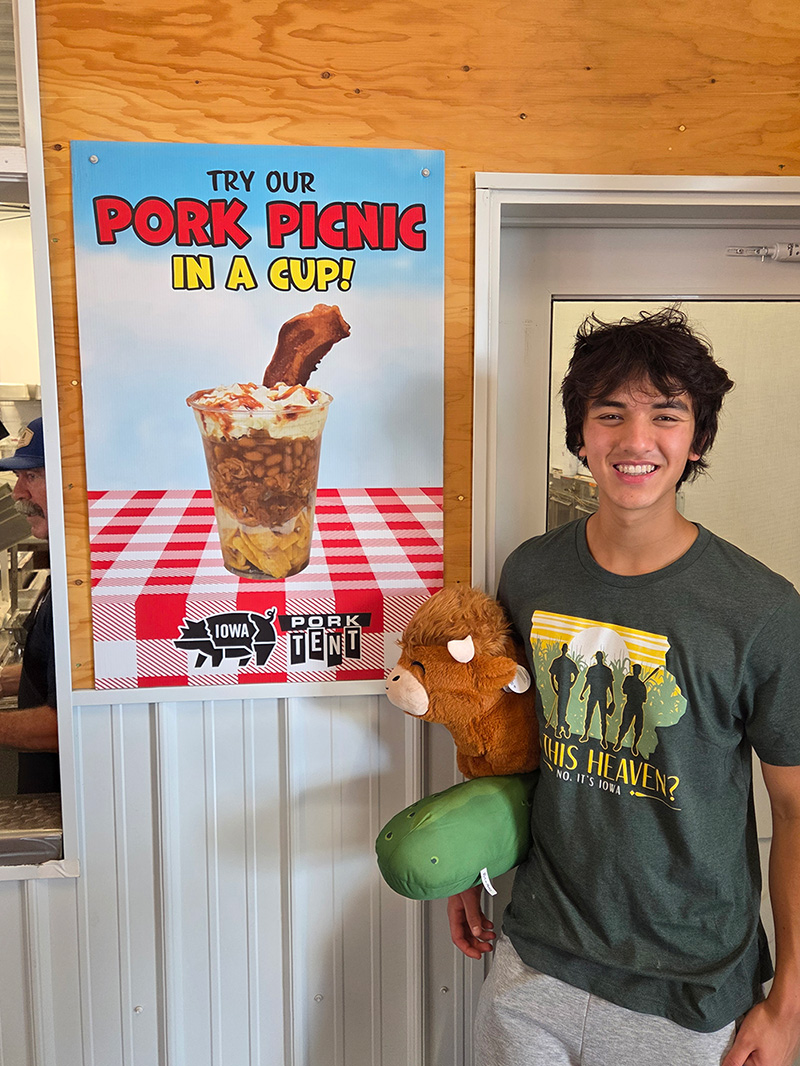
Over at the amphitheater we witnessed three pre-teen boys in unitards synchro hip hop dancing before an appreciative crowd and TV cameras. It became clear this was being broadcast live on Des Moines KCCI because the unitards were followed by an onstage weather report from Storm Team 8, then a weatherman interviewing an Iowan who’d just won the blue ribbon for longest beard (+ 3rd place in the best-groomed beard category). Lunch was hit and miss: enjoying the “world’s greatest hero,” fresh giant pretzels, and pickle pizza while nimbly avoiding various and sundry deep-fried foods on sticks, butter-dipped ice cream (yes, ice cream dipped in butter), and the Iowa Pork Tent’s infamous Pork Picnic in a Cup.
But the highlight was the William C. Knapp Varied Industries Building where the boys went on a “treasure hunt” courtesy of the Iowa Treasurer’s office: “Iowa’s only legitimate source of unclaimed property.” Then they posed for a photo with an inflatable Herbert Hoover and got creationist tattoos: a green dinosaur holding a bible with the caption “GOD CREATED DINOSAURS AND PEOPLE ON DAY 6!”

It was a great day, particularly considering how it began: my youngest son Zev set out on an early morning run, got off course, and somehow returned to the wrong hotel. We figured it out when he said he was outside room 418, but wasn’t. Then when we arrived at the Fair, we headed straight for the giant maze, which in retrospect was no place for a boy who couldn’t find his way back to the right hotel.
To be fair, we’d arrived late the prior evening and Zev hadn’t seen his surroundings in the daylight. Plus the hotel where he ended up looked nearly identical. Still, it was evident that this academically-inclined child lacks some practical skills. Which became even clearer at the Fair when he failed the Pepsi Challenge twice in a row.
So I was intrigued when, upon my return from the Hawkeye State, Apprenticeships for America Chairman Bob Lerman forwarded new research out of Switzerland. The paper, titled The Value of Practical Skills, accomplishes something novel. For decades, economists have understood that practical skills are a stronger predictor of employee productivity and economic outcomes than years of formal education or standardized test scores. At the same time, they’ve also believed that practical skills are occupation-specific and impractical-verging-on-impossible to define and measure. That’s a big reason why postsecondary degrees became a proxy for human capital, college-for-all became a national religion, and degree inflation continues to ravage the labor market.
In the past I’ve made light of Switzerland and the workforce voyeurs who saunter across the pond to enjoy wine, fondue, and survey apprenticeship nirvana. While the success of the Swiss system is due to structural and cultural factors that are impossible to scale here – sorry Indiana – one element turns out to be extremely instructive. The researchers homed in on Switzerland’s end-of-apprenticeship assessments which test three things independently: (1) general knowledge; (2) industry/job knowledge; and (3) practical skills. While the first two are classroom-based tests, the latter involves industry experts observing apprentices perform real work for hours, days, and sometimes weeks. And because the researchers were able to match assessments with subsequent employment, they were able to measure the relative importance of skills gained in classrooms vs. skills gained on the job for successful career launch.
Here’s what they conclude:
1. Practical skills are by far the strongest predictor of economic outcomes; apprentices with strong practical skill marks but middling classroom performance do much better than those with strong classroom grades and weaker practical skills. (Strong classroom performance is really only predictive of a return to formal postsecondary education.)
2. Practical skills are only weakly correlated with the two classroom-graded measures. So they’re not a byproduct of being a good student; they need to be built separately.
You might say, sure, this makes sense because apprentices work with their hands in blue-collar jobs. But the data cover 200+ apprenticeable occupations. And because Switzerland is the Iowa State Fair of apprenticeships, that means a wide range of white-collar professions in tech, financial services, healthcare, design, marketing, and sales.
So if practical skills are strongly correlated with economic outcomes, shouldn’t we ensure that our eye-watering investment in postsecondary education yields a modicum of practical skills? And if so, how? The researchers advise that “practical skills become visible primarily through the execution of authentic occupational tasks under real working conditions.” In other words, practical skills are occupation-specific and built through repetitive solving of real problems in the workplace. This explains why, as I discussed last time, workforce training programs delivered in classrooms – outside the workplace and divorced from real employers and real work – are destined to fail.
While classrooms and workplaces produce genuinely different kinds of human capital, it turns out that one is a much better predictor of whether a young person will launch successfully. Obviously, career launch and economic outcomes aren’t all we care about. We also need to produce informed citizens, friendly neighbors, compassionate family members, and colleagues who are enlightened rather than benighted. But those other important outcomes likely fall by the wayside without economic security. So the Swiss results make one thing abundantly clear: for all forms of postsecondary education – training programs, certificate programs, and degrees – we’ve dramatically overestimated the value of classroom-based learning and correspondingly underestimated the value of work-based learning.
Another possible objection: Swiss apprentices may have a higher baseline of literacy, numeracy, civic, and basic cognitive skills thanks to a less dysfunctional K-12 system. So because their primary and secondary classrooms are more effective, they don’t need college classrooms as much as their American counterparts. That’s fair, and I’m not saying we don’t need college classrooms. We just don’t need as many. For the vast majority of young Americans seeking to meet or exceed their parents’ standard of living, the solution isn't more classroom hours or credentials, it's ensuring they receive meaningful, in-field work experience before pursuing a full-time job search. Otherwise their college degrees are deep-fried. And we’d best abandon the view that just because students sit in classrooms in high school, they should continue doing so for four more years. That’s like the drunk who stumbles out of the bar and, upon discovering his keys are lost, looks only under the streetlight.
***
Speaking of drunks, back at the Iowa State Fair, the most prominent industry in the Varied Industries building was higher ed. Seemingly every college in Iowa (and a few from adjacent states) felt compelled to pay for a booth and give away trinkets to attract applicants. Among them, Des Moines Area Community College. For community college trivia buffs, DMACC is one of only five institutions to prominently feature “area” in its name.
Name notwithstanding, DMACC was attracting more interest than the dozens of four-year schools pushing their majors and mascots. And not by accident: postsecondary programs with continued strong employment outcomes and long waiting lists tend to be the most applied. Of course DMACC programs still have plenty of classroom instruction. But there’s more balance with projects and real work experience where students can begin to build practical skills.
Last week, the Wall Street Journal ran a profile of University of Toronto English professor Randy Boyagoda (including a glowing review of his new satire of higher education, Lords of Serendipity). In it, the Journal quotes Boyagoda as saying “it’s absurd that we live in societies that make the decision to take people between the ages of 18 and 22, when they are most physically capable of contributing to our nations and communities, and tell them, ‘Go away for four years, and read and learn and have conversations.’” This “lock ‘em away” mentality is why millions of aspiring career launchers are struggling to combine degrees with apprenticeships and internships, and why so many innovators and social entrepreneurs are working on new higher education models that do a better job balancing classrooms with work.
The urgency only ratchets up from here. The Swiss researchers end their paper on an ominous note: “Advances in artificial intelligence increasingly substitute for tasks based on codified knowledge while potentially increasing the relative importance of capabilities that require the execution, adaptation, and transmission of occupation-specific knowhow.” In other words, expect AI to further depress the relative value of classroom-based learning and increase the relative value of work-based learning.
With their focus on simple, profitable classroom-based learning and disregard of more difficult-to-organize, difficult-to-measure work-based learning, all but one of the colleges exhibiting in the William C. Knapp Varied Industries Building have been enjoying the educational equivalent of an Iowa Pork Picnic in a Cup. If they wish to remain vibrant – or merely afford booths at future state fairs – colleges will need to figure out how to reorient their programs around work-based learning.
So it turns out Zev and colleges have something in common: they both need an Iowa course correction.